A NOC code is a five-digit number assigned by the Canadian government to classify every occupation in the national labor market. Used across statistical research, job postings, and immigration processing, it standardizes work experience requirements across the country. If you are applying for a Canadian work permit, Express Entry, or permanent residence (PR), selecting the correct code is an essential step.
What Is a NOC Code?
NOC stands for National Occupational Classification. Maintained by Employment and Social Development Canada (ESDC) alongside Statistics Canada, this framework groups thousands of job titles under standardized profiles.
Instead of treating titles like “Administrative Assistant,” “Office Coordinator,” and “Executive Support Specialist” as unrelated positions, the NOC system gathers roles sharing similar core responsibilities under a single classification code, concise description, and standardized skill level requirement.
Why NOC Codes Matter
-
Immigration Eligibility: Immigration, Refugees and Citizenship Canada (IRCC) evaluates your work experience against NOC standards to determine eligibility for programs like Express Entry, Provincial Nominee Programs (PNPs), and open or closed work permits.
-
Labor Market Statistics: Statistics Canada tracks job growth, national wage averages, and industry employment trends using these uniform codes.
-
Job Postings and Fair Wages: Platforms like Job Bank organize listings by NOC code to ensure wage transparency and consistent labor reporting.
Important: Selecting an incorrect NOC code on an immigration application can lead to processing delays or application refusals if your provided employment reference letters do not match the official duties listed for that code.
How Canada’s 5-Digit NOC Code Structure Works
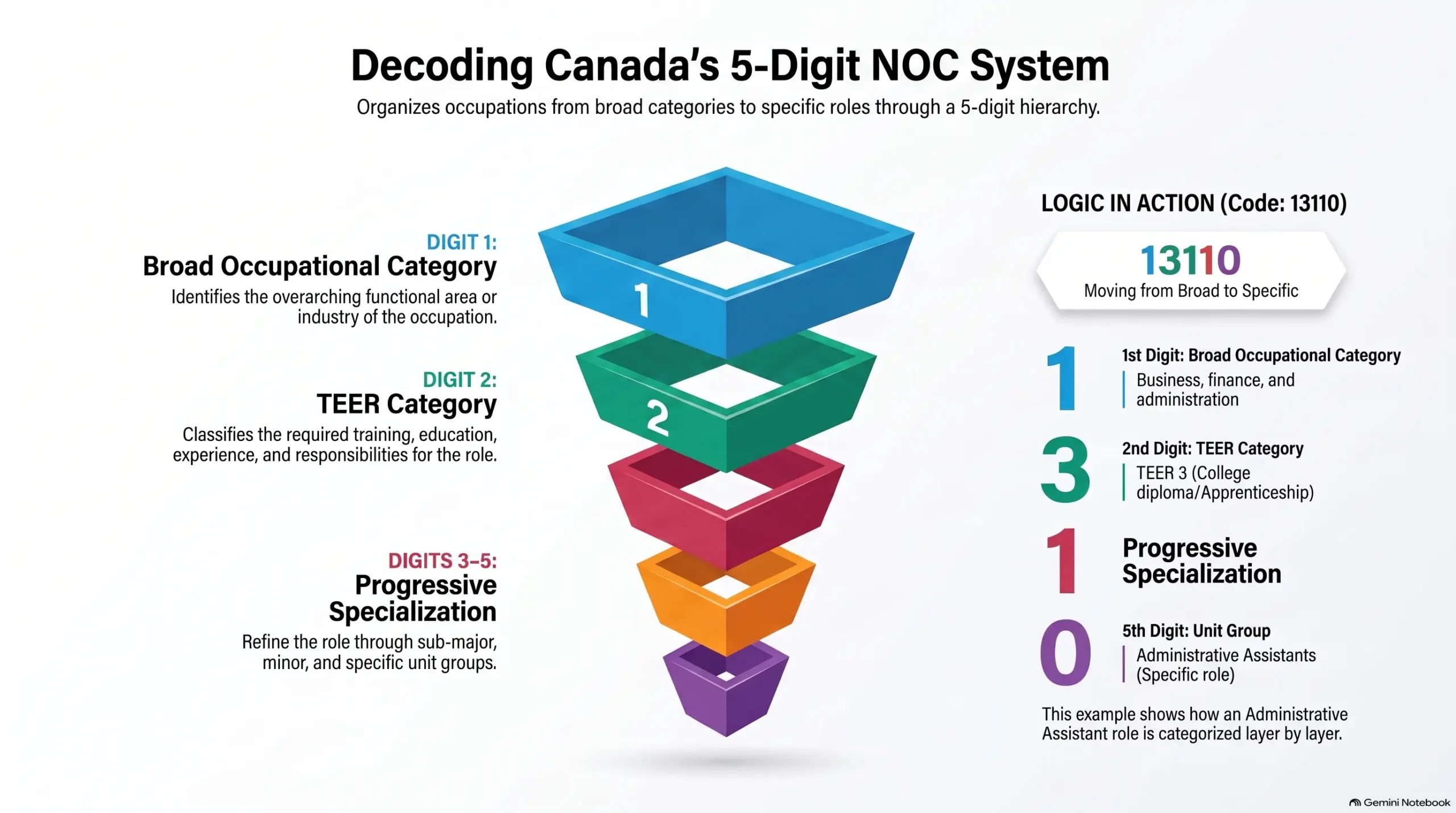
Every NOC 2021 code contains five digits. Each digit signifies a specific organizational layer within the overall system:
| Digit Position | Classification Layer | Example Meaning (Code: 13110) |
| 1st Digit | Broad Occupational Category | 1 = Business, finance, and administration |
| 2nd Digit | TEER Category | 3 = TEER 3 (College diploma/Apprenticeship) |
| 3rd Digit | Sub-Major Group | 1 = Financial, secretarial, and administrative tools |
| 4th Digit | Minor Group | 1 = Administrative support occupations |
| 5th Digit | Unit Group | 0 = Administrative Assistants (Specific role) |
Understanding TEER Categories (NOC 2021)
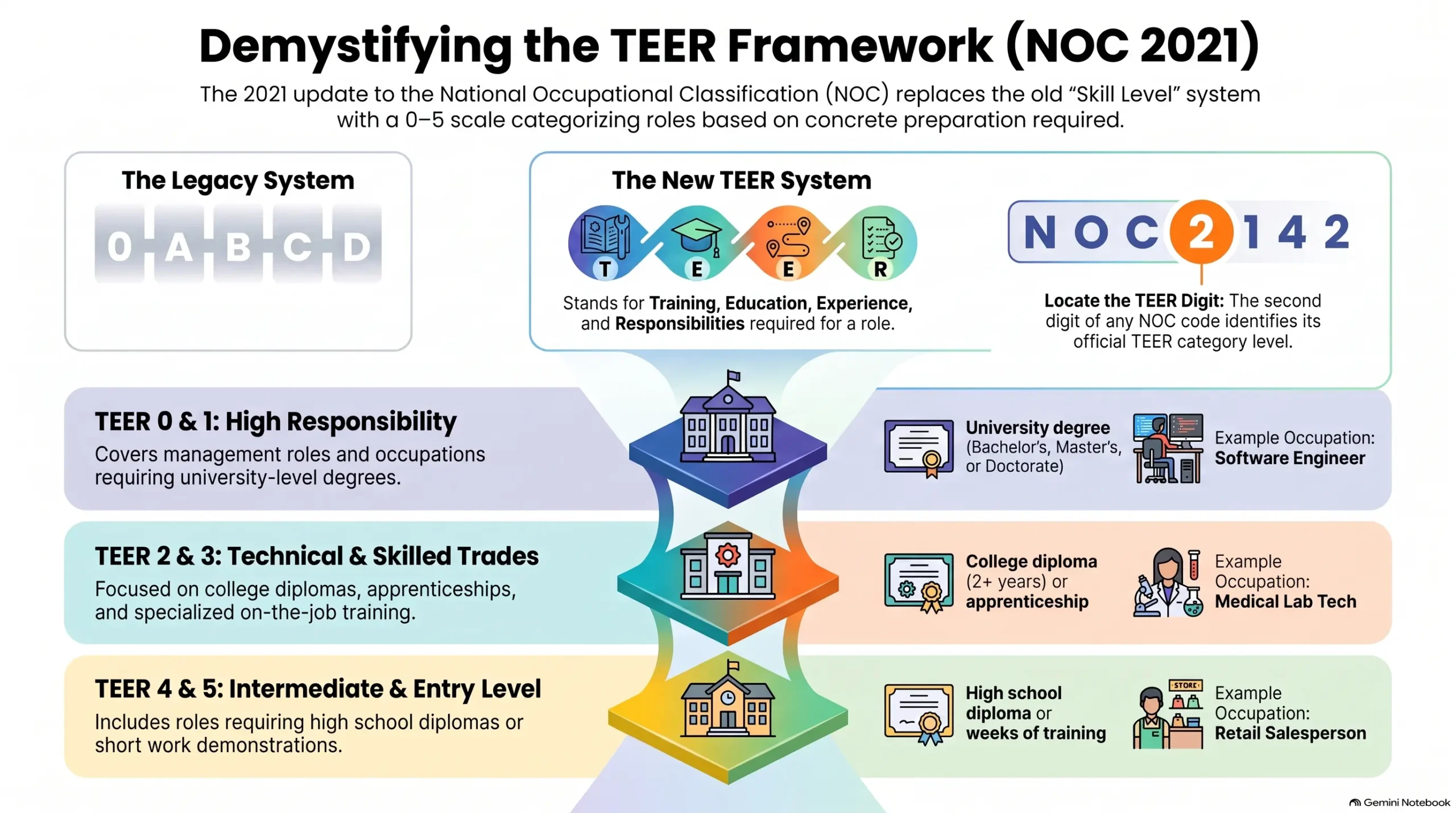
TEER stands for Training, Education, Experience, and Responsibilities. It represents the classification framework introduced in the NOC 2021 update to replace the legacy “Skill Level” system (0, A, B, C, D).
Instead of broad skill categories, TEER evaluates the concrete preparation and oversight required for a role. The second digit of any NOC code indicates its official TEER category (0 through 5).
| TEER Level | Typical Requirements | Example Occupations |
| TEER 0 | Management responsibilities | Advertising/PR Managers, Executive Directors |
| TEER 1 | University degree (Bachelor’s, Master’s, or Doctorate) | Software Engineers, Financial Analysts |
| TEER 2 | College diploma (2+ years), 2+ years of apprenticeship, or supervisory roles | Administrative Assistants, Medical Laboratory Techs |
| TEER 3 | College diploma (<2 years), apprenticeship (<2 years), or 6+ months of on-the-job training | Bookkeepers, Bakers, Dental Assistants |
| TEER 4 | High school diploma, or several weeks of job-specific training | Customer Service Representatives, Retail Salespersons |
| TEER 5 | Short work demonstration; no formal education required | Delivery Drivers, General Laborers, Cleaners |
Key Differences: NOC 2016 vs. NOC 2021
Since November 16, 2022, all Canadian immigration programs require the NOC 2021 system.
-
5-Digit Codes Replace 4-Digit Codes: The expanded length offers higher precision for modern tech, healthcare, and skilled trade roles.
-
TEER System Replaces Lettered Skill Levels: Skill Types 0, A, B, C, and D were retired in favor of TEER categories 0 to 5.
-
Updated Industry Definitions: Legacy codes (e.g., old NOC 1241 for administrative staff) are obsolete. The updated NOC 2021 equivalent is 13110.
Step-by-Step: How to Find Your Correct NOC Code
-
Access the Official Directory: Visit the official ESDC NOC tool at
noc.esdc.gc.ca. -
Search by Duties, Not Just Job Titles: Enter your current or past job title, but treat the result as a draft. Employer titles vary widely across companies.
-
Review the “Main Duties” Section: Read the bulleted lead statement and duties list carefully. IRCC evaluates your official employment reference letters against these core duties, not your title.
-
Apply the 80% Rule: Ensure your actual daily responsibilities match at least 75–80% of the main duties listed under the unit group.
-
Check the Exclusions: Review the “Exclusions” section at the bottom of the profile page to confirm your role is not explicitly redirected to a different NOC code.
-
Identify the Second Digit: Verify the second number in the 5-digit code to confirm your official TEER level for immigration scoring.
NOC Codes and Express Entry Eligibility
For Canada’s main economic immigration programs operated through Express Entry—the Federal Skilled Worker (FSW) program, Canadian Experience Class (CEC), and Federal Skilled Trades (FST)—only work experience in TEER 0, 1, 2, or 3 qualifies as eligible skilled work.
-
Eligible for Express Entry: TEER 0, TEER 1, TEER 2, and TEER 3.
-
Ineligible for Express Entry: TEER 4 and TEER 5.
- Once you’ve confirmed your occupation is TEER 0–3, the next step is understanding which immigration or work permit pathway actually fits your situation — our guide on jobs in Canada for foreigners walks through the main routes in.
Note: Work experience in TEER 4 or 5 may still qualify for alternative pathways, including specific streams under the Provincial Nominee Program (PNP), the Atlantic Immigration Program (AIP), or temporary work permits.
5 Common Mistakes to Avoid
-
Choosing a Code Based Solely on Job Title: Internal company titles are often misleading. Focus strictly on duties and responsibilities.
-
Confusing Supervision with Management: Supervisory positions usually fall under TEER 2, whereas true management roles with hiring/budgetary oversight fall under TEER 0.
-
Submitting Outdated 4-Digit Codes: Applications referencing NOC 2016 numbers will be flagged or rejected as incomplete.
-
Exaggerating Duties to Fit a Higher TEER: Misrepresenting duties to qualify for TEER 0–3 can result in application refusal or a finding of misrepresentation.
-
Ignoring the Exclusion List: Failing to check related titles and exclusions listed on the ESDC profile page often leads to misclassification.
Frequently Asked Questions
What is a NOC code used for?
A NOC code standardizes occupation reporting across Canada. It is used by Statistics Canada for economic tracking and by IRCC to evaluate work experience for work permits, Express Entry, and PR pathways.
How do I find my exact NOC code?
Search the official ESDC NOC database using key terms from your daily work. Select the profile where the listed “Main duties” closely match the responsibilities documented in your employment reference letters.
What is the primary difference between NOC and TEER?
NOC is the overarching classification framework for all jobs. TEER is the specific metric (levels 0–5) within the NOC system that measures necessary training, education, experience, and responsibility.
Is TEER 3 considered skilled work for Canadian PR?
Yes. TEER 0, 1, 2, and 3 are all classified as skilled work experience for federal economic immigration programs managed through Express Entry.
Can my real job title differ from the official NOC unit group title?
Yes. Job titles vary by employer. IRCC evaluates the daily responsibilities documented in your official job description and reference letters rather than the exact wording of your job title.
Key Takeaways
-
Every Canadian occupation is classified under a 5-digit NOC 2021 code.
-
The second digit of the code indicates the job’s TEER level (0–5).
-
TEER 0, 1, 2, and 3 qualify as skilled experience for Express Entry programs.
-
Base your NOC selection on documented daily duties, not your official job title.
-
Always verify code definitions directly on the official ESDC portal before submitting an immigration application.