Foreigners can legally work in Canada by securing a job offer tied to a valid work permit — usually through the Temporary Foreign Worker Program, the International Mobility Program, or Express Entry. Getting hired isn’t automatic: it depends on your occupation, whether an employer is approved to hire abroad, and which immigration stream fits your situation.
This guide breaks down exactly how the process works, which jobs are actually hiring foreign workers right now, realistic salary numbers, and a step-by-step application plan — without the vague advice most articles repeat.
Can Foreigners Actually Get Jobs in Canada?
Yes. Canada issued over 1.05 million total work permits (temporary and permanent combined) in recent years, and labour shortages in healthcare, skilled trades, transportation, and agriculture mean many employers are actively recruiting internationally. But a job offer alone isn’t enough — you generally need one of the following to work legally:
- A valid work permit tied to a specific employer (closed permit), or
- An open work permit not tied to one employer, or
- Permanent residency through Express Entry or a Provincial Nominee Program (PNP)
Current public data on exact 2026 approval rates by occupation is limited, so always verify quotas and processing times directly on the IRCC website before applying.
How the Canadian Work Permit System Works
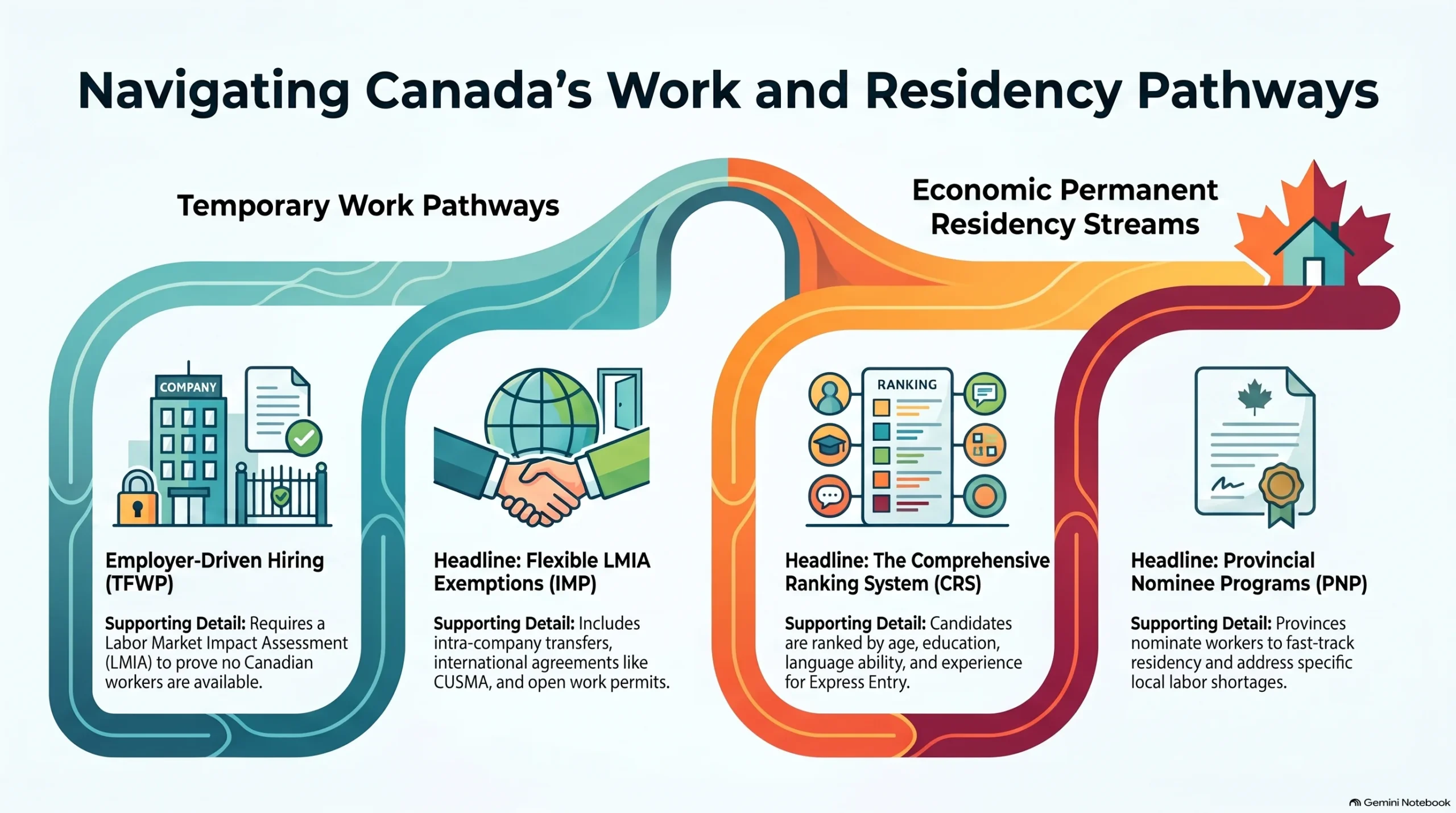
Temporary Foreign Worker Program (TFWP)
Under the TFWP, a Canadian employer must first get a Labour Market Impact Assessment (LMIA) — proof that no Canadian worker is available for the role — before hiring you. Once approved, you apply for a closed work permit tied to that employer and job.
International Mobility Program (IMP)
The IMP lets employers hire foreign workers without an LMIA in specific cases: intra-company transfers, CUSMA/USMCA professionals, international agreements, or open work permit holders (like spouses of skilled workers or international graduates).
Express Entry (Path to Permanent Residency)
Express Entry manages three federal economic immigration programs — Federal Skilled Worker, Federal Skilled Trades, and Canadian Experience Class. Candidates are ranked by a Comprehensive Ranking System (CRS) score based on age, education, language ability, and work experience, and top-ranked candidates receive an Invitation to Apply (ITA).
Provincial Nominee Programs (PNP)
Each province runs its own PNP targeting specific in-demand occupations. A provincial nomination adds significant CRS points and can fast-track permanent residency, especially in provinces like Alberta, Saskatchewan, and Atlantic Canada facing acute labour shortages.
LMIA vs. LMIA-Exempt Jobs: Key Differences
| Factor | LMIA-Based Job | LMIA-Exempt Job |
|---|---|---|
| Employer requirement | Must prove no Canadian available | Covered by trade agreement or exemption category |
| Processing speed | Slower (weeks to months) | Generally faster |
| Common categories | Agriculture, caregiving, hospitality, low-wage roles | Intra-company transfers, CUSMA professionals, open permits |
| Employer cost | LMIA application fee (employer-paid) | Usually no LMIA fee |
| Best for | Sector-specific hires with clear shortages | Skilled professionals, spouses, international grads |
Sectors Actively Hiring Foreign Workers in 2026
Healthcare
Nursing, personal support work, pharmacy, and lab technology remain chronically short-staffed across almost every province. Many provinces run dedicated pathways for internationally educated nurses, though licensing and credential recognition can take months.
Skilled Trades
Welders, electricians, carpenters, and CNC operators are consistently in demand, particularly in Alberta, Ontario, and British Columbia. Red Seal certification (or a path toward it) significantly improves hiring chances.
Transportation and Logistics
Long-haul truck driving is one of the most accessible entry points for foreign workers, with multiple provinces offering dedicated PNP streams for commercial drivers.
Agriculture and Food Processing
Seasonal and year-round roles in farming, food packing, and processing plants frequently hire through the TFWP’s agricultural stream, often with employer-provided housing.
Technology
Software developers, data analysts, and cybersecurity professionals are in demand in Toronto, Vancouver, and Montreal tech hubs, though competition is higher and most roles require a strong portfolio or Canadian-equivalent credentials.
Hospitality and Caregiving
Hotels, restaurants, and home-care agencies regularly recruit internationally, especially in tourist-heavy regions and for live-in caregiver positions.
Realistic Salary Ranges by Sector (CAD, Annual)
| Sector | Entry-Level | Experienced |
|---|---|---|
| Registered Nurse | $65,000–$75,000 | $85,000–$100,000+ |
| Truck Driver (long-haul) | $50,000–$60,000 | $70,000–$85,000 |
| Welder | $45,000–$55,000 | $65,000–$80,000 |
| Software Developer | $60,000–$75,000 | $95,000–$130,000+ |
| Personal Support Worker | $35,000–$42,000 | $45,000–$52,000 |
| Warehouse/Labour | $32,000–$38,000 | $40,000–$48,000 |
Actual pay varies by province, employer, and union status — always confirm current figures against the official Job Bank wage report before negotiating.
Step-by-Step: How to Get a Job in Canada as a Foreigner
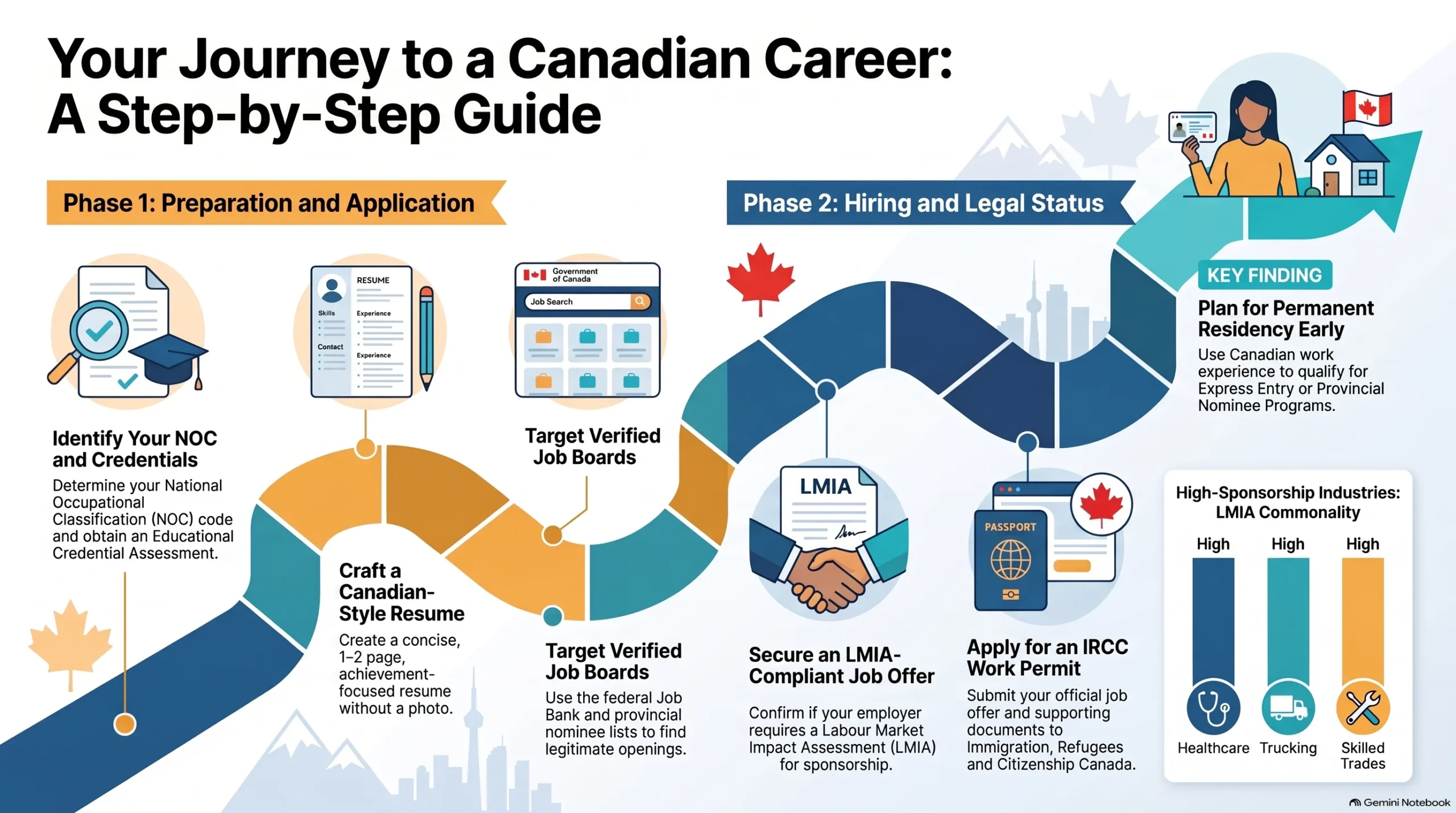
- Check your occupation’s National Occupational Classification (NOC) code. This determines which immigration streams you qualify for.
- Get your credentials assessed if applying through Express Entry (via an Educational Credential Assessment, or ECA).
- Build a Canadian-style resume and cover letter — concise, achievement-focused, no photo, 1–2 pages.
- Search verified job boards — Job Bank (the federal government’s official listing site), provincial nominee employer lists, and LMIA-approved employer directories.
- Apply directly to employers known to sponsor foreign workers, especially in healthcare, trucking, and skilled trades where LMIA approvals are common.
- Secure a job offer. Confirm whether the employer will pursue an LMIA or if the role is LMIA-exempt.
- Apply for your work permit through IRCC with your job offer, LMIA (if required), and supporting documents.
- Plan your transition to permanent residency early — many temporary workers become eligible for Express Entry or PNP nomination after gaining Canadian work experience.
Common Mistakes Foreign Job Seekers Make
- Applying to unverified “visa sponsorship guaranteed” job posts instead of Job Bank or employer career pages directly
- Ignoring credential recognition requirements for regulated professions (nursing, engineering, teaching)
- Underestimating processing times and applying too close to a planned move date
- Sending generic, non-localized resumes that don’t follow Canadian formatting norms
- Assuming a job offer alone guarantees a work permit approval
Who Should Be Cautious About This Path
Foreign job seekers in regulated professions (law, medicine, teaching, engineering) should expect a longer runway, since provincial licensing bodies — not just immigration authorities — must recognize your credentials. Similarly, applicants targeting low-wage LMIA streams should verify the employer’s LMIA approval directly with Service Canada, since low-wage positions are a common target for recruitment fraud.
Frequently Asked Questions
Can a foreigner get a job in Canada without a work permit? No. With very limited exceptions (business visitors, some IMP categories), you need a valid work permit before starting employment in Canada. Working without one can affect future immigration applications.
What is the fastest way to get a job in Canada as a foreigner? LMIA-exempt categories under the International Mobility Program — such as intra-company transfers or CUSMA professional streams — are typically faster than standard LMIA-based hiring, since they skip the labour market test.
Do I need a job offer before applying for Express Entry? No. A job offer isn’t required to enter the Express Entry pool, though it can add CRS points. Many candidates receive an Invitation to Apply based on age, education, and language scores alone.
Which Canadian provinces are easiest to get hired in as a foreigner? Provinces facing acute labour shortages — including Saskatchewan, Manitoba, Alberta, and Atlantic provinces like Nova Scotia and New Brunswick — often run PNP streams specifically targeting foreign workers in high-demand occupations.
Is a college diploma enough to get a skilled job in Canada? It depends on the occupation. Skilled trades often value certification (like Red Seal) over a degree, while regulated professions require accredited education plus licensing exams regardless of diploma level.
How long does a Canadian work permit application take? Processing times vary by country of application and permit type, ranging from a few weeks to several months. Always check current processing times on the IRCC website before planning your move.
Can my spouse work in Canada if I get a work permit? In many cases, spouses of skilled temporary workers qualify for an open work permit, allowing them to work for any employer in Canada without needing a separate job offer.
Are remote jobs in Canada open to foreigners living abroad? Remote roles advertised by Canadian companies are sometimes open to overseas applicants, but most still require legal work authorization if you’ll be physically working from within Canada.
What happens if my LMIA-based job ends early? Your work permit is typically tied to that specific employer, so losing the job usually means you need a new offer and, in many cases, a new LMIA, unless you hold an open work permit.
Can international students in Canada get a foreigner work permit after graduation? Yes — the Post-Graduation Work Permit (PGWP) allows eligible international graduates to work for any employer in Canada for up to three years, often serving as a bridge to permanent residency.
Key Takeaways
- A job offer alone doesn’t authorize you to work in Canada — you need a valid work permit.
- LMIA-based roles require employer proof that no Canadian is available; LMIA-exempt roles skip this step.
- Healthcare, skilled trades, trucking, and agriculture currently offer the most realistic entry points for foreign workers.
- Regulated professions require separate provincial licensing, not just immigration approval.
- Many temporary work permits can lead to permanent residency through Express Entry or a PNP.
Action Checklist
- Identify your NOC code and matching immigration stream
- Get an Educational Credential Assessment if required
- Build a Canada-formatted resume and cover letter
- Search Job Bank and verified provincial employer lists
- Confirm any job offer’s LMIA status before accepting
- Gather documents for your work permit application
- Track processing times on the official IRCC site
- Research PR pathways available after 1–2 years of Canadian work experience
3 thoughts on “Jobs in Canada for Foreigners: The Complete 2026 Guide to Working and Getting Hired”